
andhya Anand
Carnatic Vocalist & Violinist
2025 Individual Artist Fellow - NJ State Council on the Arts


Nādānubhūti - March 2026
March Event Highlights
The Nadabhuti Series – March session unfolded as a rich tapestry of rhythm, thought, and melody—featuring a Scholar Lecture by Sri. Kumar Kantan on “Konnakkol and Laya Aspects in Karnataka Sangitam,” a reflective Student Talk by Nishita Bharath Kumar on “Ramayanam through the Eyes of Sri Muthuswamy Dikshitar,” and a soulful Student Solo Recital by Saket Ashok, weaving together scholarship, perspective, and musical expression.
Konnakol and Laya Concepts in Karnataka Sangitam: An Evening with a Mridangist Sri. Kumar Kantan
Our March Nādānubhūti series was privileged to have a renowned mridangam performer and disciple of the legendary Sri.Karaikudi Mani offered a rare and engaging window into the world of South Indian classical percussion, its history, its hidden mathematics, and its living tradition.
Sri.Kumar Kantan began his own journey of learning the mridangam at age eight before relocating from India to England. The evening began on a note of profound connection when he revealed that he and our guru Smt.Sandhya Anand share the same ancestral roots in Palakkad. A small-world coincidence of how they were both connected geographically and musically set the tone for an engaging, conversational evening.
The lecture began with a brief survey of the towering figures who shaped the mridangam tradition. Tracing back to the 1940s and 50s, the speaker identified two foundational pillars: Sri. Palghat Mani Iyer of the Tanjavoor bani and Sri. Palani Subramaniam Pillai of Pudhukotai bani. He noted that the Tanjavoor bani started from Tanjavoor Sri. Vaidiyanathan Iyer continues to thrive today, pointing to the remarkable Sri. T.K Murthy, a disciple of Tanjavoor Sri. Vaidyanatha Iyer who is still performing at 100 years old. He then introduced the Pudhukotai bani through Sri. Palani Subramaniam Pillai who learnt from his own father,but the lineage traces back through Pudukkottai Sri. Dakshinamoorthy Pillai and his Guru Sri. Maanpoondia Pillai. The speaker was careful to note that the banis are living traditions not just static labels and that the greatest artists synthesize rather than simply inherit.
This brought him to his own guru, Sri. Karaikudi Mani. He proudly notes that in the 1980s, the legendary veena maestro Sri. Veena S Balachander declared that the two reigning pillars of mridangam were Umayalpuram Sri. K. Sivaraman and Sri. Karaikudi Mani - a declaration that still resonates. Sri. Karaikudi Mani, Sri. Kumar Kantan’s teacher of nearly 40 years, had studied under Karaikudi Sri. Rangu Iyengar and most notably under Sri. T.R. Harihara Sharma, father of the celebrated Ganjira and Ghatam virtuoso Sri. Vikku Vinayakram, making him a musical contemporary of Sri. Vikku Vinayakaram himself.
What made Sri. Karaikudi Mani remarkable, the speaker explained, was not simply lineage but creative synthesis. Early recordings from the 1970s reveal clear echoes of Sri. Palghat Mani Iyer in his playing. By the 1980s, however, he had forged something distinctly his own — a style that drew from the precision of the Tanjore bani and the richness of the Pudhukotai bani and welded them into what can only be called the Karaikudi Mani style. He was also a pioneer of the Talavadyam — “Shruti Laya” percussion-centered ensemble concerts in which melody served rhythm rather than the reverse — staging some 30 such concerts in the 1980s and helping popularize a format that many artists now embrace.
 Copy of 20260321_200058 |  Copy of 20260321_184810 |
|---|---|
 20260321_200324 |  |
 Copy of 20260321_184355 |  Copy of 20260321_200324 |
 Copy of IMG_20260321_175518543_HDR |  Copy of IMG_20260321_180154426_HDR |
 Copy of 20260321_182347 |  Copy of 20260321_183505 |
 Copy of IMG_20260321_182434213_HDR |  Copy of 20260321_195904 |
 IMG_7499 |
The second half of the evening turned practical and mathematical. The speaker walked the audience through foundational rhythmic concepts, carefully navigating the fact that different schools use different terminology.
In his tradition, an aksharam is the primary beat - Adi talam, for instance, has eight aksharams. Within each aksharam live smaller subdivisions called maatras, with a standard of four maatras per aksharam, giving Adi talam its 32 matras per cycle. The ratio of maatras to aksharams is called nadai (also known as gati in some schools) and it is this ratio that defines the five fundamental rhythmic speeds of Carnatic music:
Chathusra (4) - the default
Tisra (3)
Misra (7) - a mixture of 3 and 4
Khanda (5) - derived from halving 10 (7+3), with khanda meaning "cut"
Sankirna (9) - meaning complex
The audience, a lively mix of vocalists, instrumentalists, and dancers, joined in identifying the standard konnakol syllables for each nadai — ta-ka for two, ta-ki-ta for three, ta-ka-di-mi for four, and so on up to the nine-beat combinations.
A Three-Level Talam Challenge
The session's highlight was a hands-on talam exercise drawn directly from his guru’s teaching - a practice the speaker described as essential for any serious student. The exercise involves substituting a five-beat phrase (Ta-din-gi-nathom) into a four-beat context, which immediately throws the talam cycle off by one maatra and requires four full repetitions before the beat resolves back to samam. The challenge: maintaining uninterrupted flow while keeping the talam, never pausing to "wait" for the beat to return.
The speaker presented this in three levels of increasing difficulty:
Level One — performed in third speed (four matras per aksharam), in Chathusra nadai
Level Two — performed in second speed, making the off-beat displacement feel even more exposed
Level Three — performed in first speed, where the slow tempo demands the greatest mental resolve
Several volunteers from the audience attempted each level, with the speaker offering precise, encouraging feedback, noting not just rhythmic errors but the subtler challenge of simultaneously managing syllable accuracy and talam placement. The exercise, he observed, can be made even more demanding by attempting it in Khanda or Tisra nadai.
Another highlight of the evening was the deep dive into the architecture of the Korvai. The artist presented a series of self-composed patterns, created exclusively for this lecture, to illustrate the nuances of the mridangam repertoire. He masterfully broke down the Poorvangam -the three-part introductory phase, usually a multiple of 3, showing how a simple motif can evolve into a complex rhythmic web. This transitioned into the Utharangam, where he demonstrated the mathematical elegance of 5, 6, 7, and 8-beat cycles within the talam. Central to this discussion was the concept of the Karvai. While often thought of in vocal music as a sustained note, the artist explained that in the world of percussion, a karvai is a precisely measured silence. Rather than a random pause, it is a mathematical gap that gives the rhythm its shape and "weight." He concluded by illustrating these intricate patterns in an interactive session, making the complex arithmetic of the mridangam both accessible and engaging
Throughout the evening, one theme ran quietly beneath the surface: the irreplaceable role of the guru. "You have to have the guru," the speaker said simply, reflecting on his own 40-year relationship with Karaikudi Sri. Mani and the blessing of having had such a teacher. Carnatic music, he reminded the room, is not written down. It is heard, absorbed, and transmitted from one human being to another. The best students, he said, are those who hear something once and grasp it completely. Everything else is practice.
For an audience spanning beginners and advanced students, vocalists and dancers, the evening offered something rare: a direct line from the ancient to the living, from the mathematical to the laya and Korvai - Konnakol calculations — all held together by the quiet pulse of the mridangam.
Student Showcase by Nishita Bharath Kumar & Saket Ashok

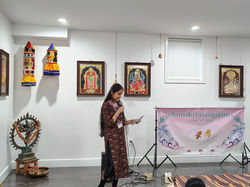
Saket, a 3rd grader at MLK Elementary, recently performed at the Nādānubhūti recital, showcasing two and a half years of training under the Smt. Sandhya Anand. With her blessings and guidance his performance featured a steady rendition of Shyamale Meenakshi in Shankarabharanam, followed by a rhythmic Jathiswaram in Malayamarutham and a smooth delivery of the geetham Vara Veena. He concluded the set with an energetic performance of Bantu Reethi Kolu in Hamsanada, demonstrating technical progress and a confident stage presence across various ragas.
The event followed with Nishita's talk on the Ramayana, focusing on the compositions of Muthuswami Dikshitar. She walked the younger kids through the story by linking key moments to different ragas starting with the joy of Rama’s birth in "Rāmachandram Bhāvayāmi" (Vasantā) and even exploring a rare eka-kriti in Ramakali. She also spoke about surrender in "Kṣhitija Rāmanam" before wrapping up with the coronation in "Māmava Pattābhirāma" (Manirangu). It was great to see her blend music with storytelling, which made it easy for her co-students to connect Dikshitar's kritis to Rama’s life.
We are so grateful to our guru Sandhya Anand and the school for giving them this invaluable platform for students to share their deepening connection to the arts and encouraging them in this process
